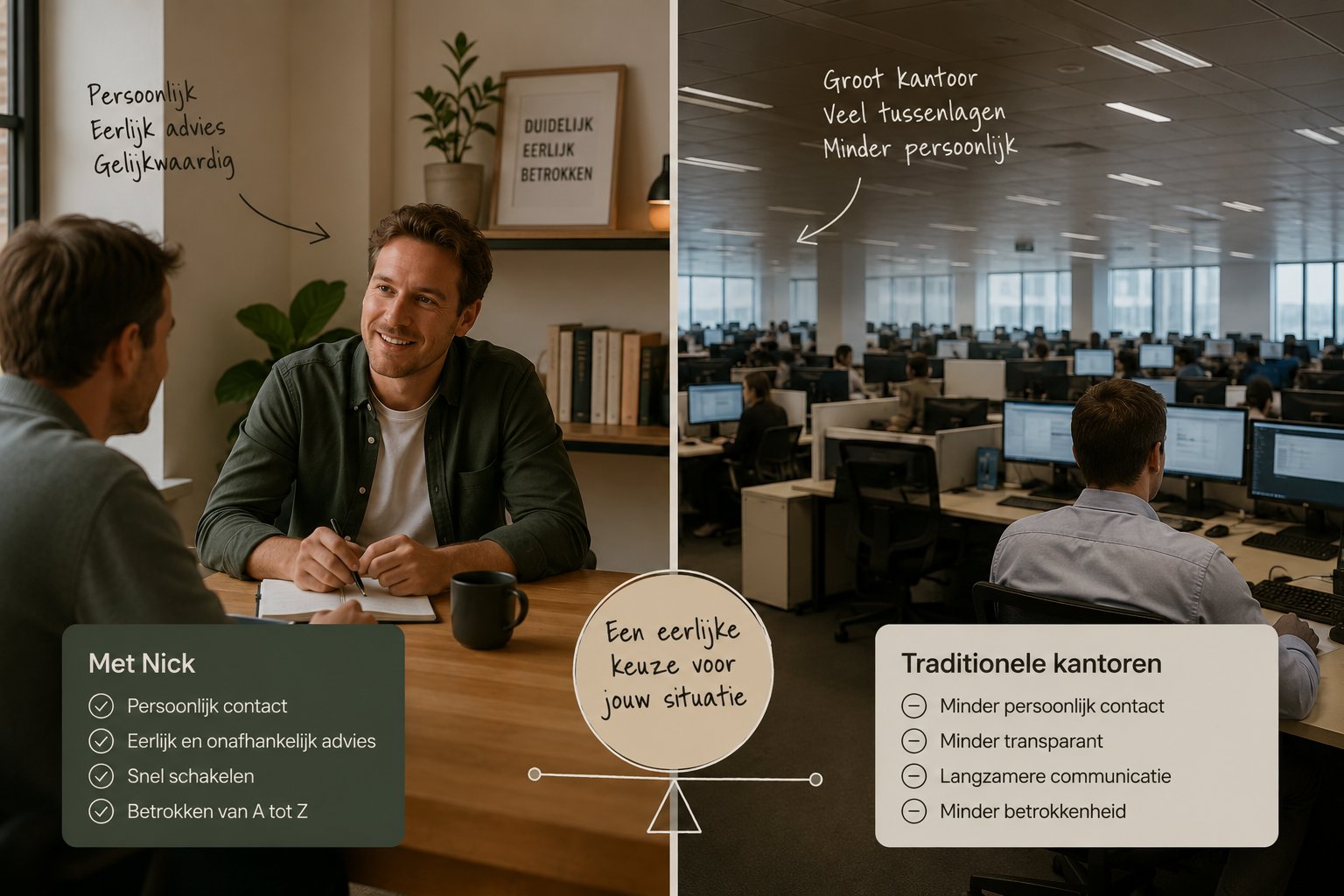

You are a good IT professional in employment, and you wonder: should I start out on my own? The higher rate beckons, but you also give up security. Is the step to freelancing worth it, or are you better off staying employed?
In this article I compare going freelance and staying employed honestly, on income, freedom, security and risk. Not a black-and-white story saying freelancing is always better, but a sober trade-off so you make a choice that fits you.
This blog is for IT professionals considering the switch to freelancing: cloud, network, DevOps and security engineers in employment.
Honest up front: I place freelancers, so I have a natural preference for the self-employed. That is why I make an extra effort to honestly name when employment is the better choice. This is also general information, not financial advice; for your figures, go to an accountant.
What is the biggest difference between freelancing and employment?
The biggest difference is the trade-off between freedom and income on one side, and security and ease on the other. As a freelancer you usually earn more per hour and decide your own work, but you carry all risks and arrange everything yourself. In employment you give up rate and freedom, but get security and being unburdened in return.
There is no objective "better". It depends on what you value: maximum earning and freedom, or stability and peace of mind. Many IT professionals underestimate how much an employer actually arranges for them, and overestimate what they keep net as a freelancer. An honest comparison helps.
Do you really earn more as a freelancer?
Per hour yes, but net it is more nuanced. Your hourly rate is considerably higher than a gross hourly wage in employment, but costs come off that your employer otherwise bore: tax, insurance, pension, and non-billable time. What you really keep is lower than the rate suggests.
On the other hand, net often still works out more favourably than employment, provided your occupancy is in order and you set your rate well. Idle time between assignments is your biggest enemy. Calculate it honestly before you jump; base your rate on your desired net, not the other way around. Want to know which cost items play a role? Read our blog on what you keep net as an IT freelancer.
What do you give up when leaving employment?
More than many people think. An employer arranges your pension, continues paying during illness, and you build up rights like unemployment benefit. As a freelancer that safety net falls away and you arrange it yourself, or not. That is no reason not to do it, but it is a reason to weigh it consciously.
The securities you give up in a row:
- Continued pay during illness: as a freelancer you stand still, unless you insure yourself
- Pension build-up via the employer: you arrange that yourself from now on
- Unemployment rights like benefit lapse
- A fixed, predictable monthly income becomes a fluctuating flow
- Paid holidays and days off no longer exist
Many of these securities you can cover yourself as a freelancer, with insurance and buffers. But that costs money, and it has to come out of your rate. So factor those costs into your trade-off, otherwise you compare apples with pears.
What do you get in return as a freelancer?
Freedom and earning potential. You choose your assignments, your clients, your rate and your working hours. You can earn more, develop yourself in the direction you want, and arrange your work to suit you. For many IT professionals, that autonomy is the decisive factor.
In addition, the IT market is favourable for the self-employed. Demand for cloud, DevOps and security specialists is high, and good freelancers are rarely without work. That makes the step less risky than in many other sectors, provided you have a sought-after profile.
How do you know whether freelancing suits you?
Ask yourself a few honest questions. Do you have a sought-after profile and a network or a way to find assignments? Can you handle uncertainty and fluctuating income? Do you enjoy, or accept, doing acquisition and admin alongside your work? The more yes, the better freelancing fits.
Unsure about the security, then there is a middle ground. You can start as a freelancer and limit the risk by working via an intermediary, who helps you to a stable flow of assignments and arranges Dutch DBA Act compliance. That way you combine the freedom of freelancing with more security. Want to know how that works? Read our comparison of working directly or via an intermediary.
Frequently asked questions about freelancing or employment
Do I really keep more as a freelancer?
Per hour you earn more, but net the difference is smaller due to tax, insurance, pension and non-billable time. With good occupancy it often still works out more favourably than employment. Calculate it honestly with an accountant before you decide.
Is freelancing risky in IT?
Less than in many other sectors, because demand for IT professionals is high. Good cloud, DevOps and security specialists are rarely without work. The risk lies mainly in idle time and having to arrange your own safety net, not so much in a lack of assignments.
Can I go back to employment if freelancing disappoints?
Yes, that is always possible. The IT labour market is tight, so experienced IT professionals usually easily find a permanent job again. In fact, your freelance experience is often a plus. The step to freelancing is therefore less irreversible than it feels.
Must I go full-time freelance straight away?
Not necessarily. Some start with a few assignments alongside a job to test the water, although that must fit with your employer. If you start full-time, ensure a buffer for the first months. A gradual start can reduce the uncertainty.
What do I do about pension and insurance as a freelancer?
You arrange those yourself. Think of disability insurance and your own pension provision. They are serious cost items you must build into your rate. Get advice on this from a financial advisor, so you are not left without a safety net.
Conclusion: a conscious choice, not an automatism
Going freelance gives you more freedom and earning potential, but you give up security and arrange everything yourself. Employment gives peace of mind and being unburdened, at a lower income and less autonomy. The best choice depends on your profile, your risk appetite and what you value.
For whom is freelancing the right step? For IT professionals with a sought-after profile who put freedom and earning above security, and can handle uncertainty. For whom not? For those mainly seeking stability and peace of mind, or with a less sought-after profile.
My honest advice: calculate it through, weigh not only the rate but also what you give up, and consider that a middle ground via an intermediary can reduce the uncertainty. A conscious choice is always better than a leap in the dark.
Unsure about the switch to freelancing?
Want to spar about whether freelancing suits you, and how to find a stable flow of assignments? Plan a no-obligation call with me. I think along peer-to-peer, honestly and with no sales pitch.
Want to explore assignments via Maedium? See how you can join.
Note: this article is general information, not financial or tax advice. For your personal situation, consult an accountant or financial advisor. Regulations and figures may change.