
You are looking for IT capacity and considering a secondment agency. But there are also smaller intermediaries like Maedium, who work differently. What is the difference, and when does each model fit your situation?
In this article I compare Maedium with a traditional secondment agency, honestly and with an open visor. You will read the difference in model, cost, approach and risk, and I am honest about when a secondment agency is the better choice. No sales pitch.
This blog is for clients: IT managers and hiring managers looking for capacity who want to choose the right partner.
Honest disclosure up front: I am Nick, owner of Maedium. I am comparing my own company with another model here, so I have an interest in the outcome. That is why I make an extra effort to be honest about what a secondment agency does better. Judge for yourself.
What is the difference between secondment and intermediation?
With secondment, the IT professional is often employed by the agency, which places them with you. The agency is the employer, pays payroll tax, and charges a margin that covers those employer costs. With intermediation, as Maedium does, the IT professional stays an independent entrepreneur and no one becomes the employer.
That difference carries through into everything: the cost, the flexibility and the relationship. A secondment agency offers permanent people with security; an intermediary connects you with independent specialists. Neither is better by definition, but they fit different needs. Want to understand the distinction between the Maedium constructions exactly? Read our comparison of the intermediary construction and intermediation.
How do the costs differ?
With a secondment agency you pay a rate that covers the agency's employer costs and margin; the IT professional is, after all, often employed. With Maedium you pay the independent's rate plus a fee of about 10 to 15 percent, without employer costs, because the IT professional stays a freelancer.
That often makes intermediation more cost-efficient, especially with the intermediary construction, because there are no employer costs in the rate. But note: a secondment agency offers something in return, namely the security of someone employed and often more continuity. You pay for a different kind of security.
How do the approach and personal attention differ?
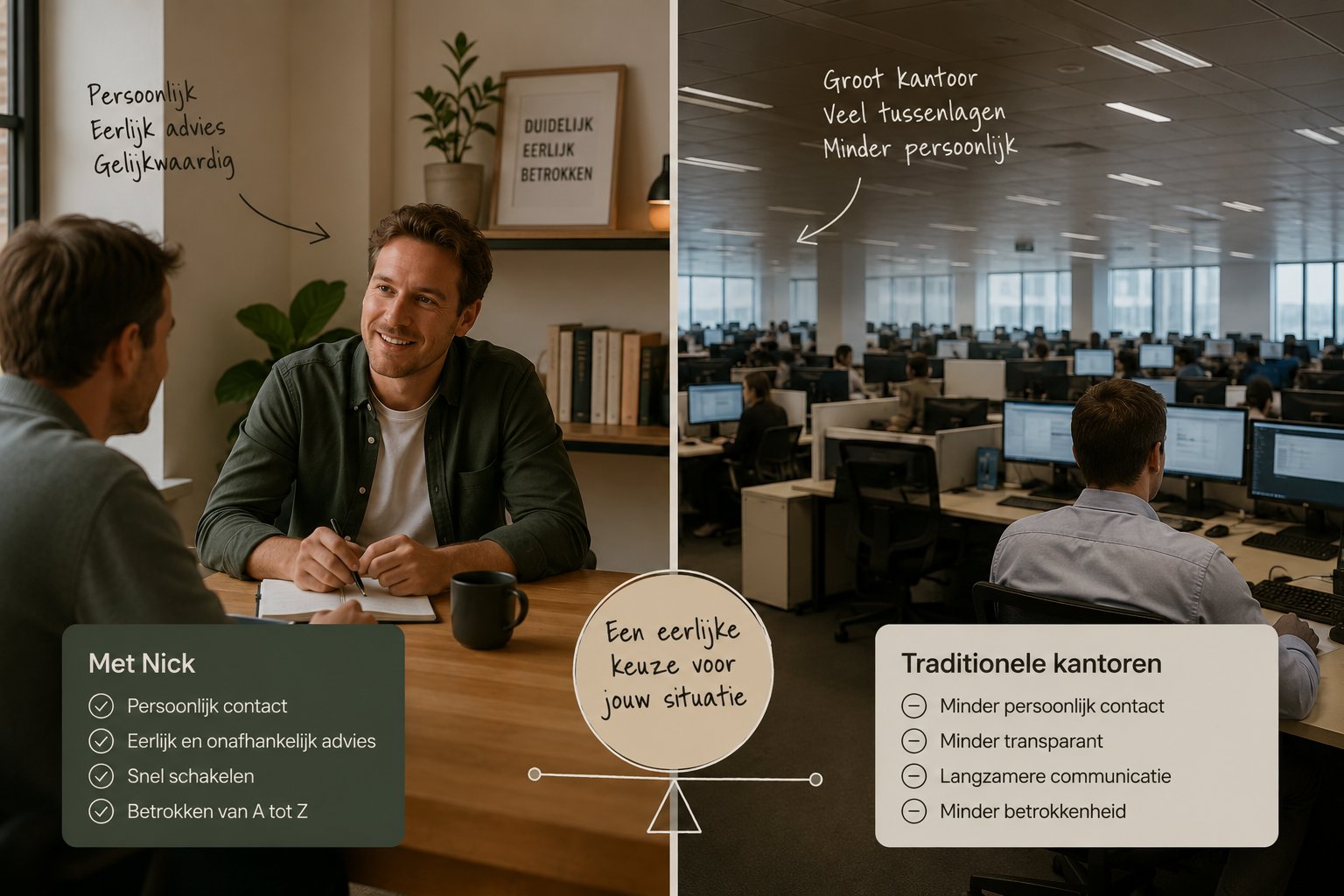
A large secondment agency works on volume, with account managers and a large pool. That gives clout, but you are one client of many. Maedium is a small, personal party: I speak to everyone myself, know the freelancers personally, and have short lines. That gives involvement, but less volume.
This is an honest trade-off. If you want a fixed point of contact who really knows your assignment and thinks along, a small intermediary fits. If you want a streamlined process with lots of capacity and standardisation, a large agency is better equipped for that. It depends on what you value more.
Who carries the Dutch DBA Act risk?
With secondment, the IT professional is employed by the agency, so the Dutch DBA Act does not play a role in the same way; the agency is the employer. With Maedium, the IT professional stays independent, and I cover the Dutch DBA Act risk via the intermediary construction, safeguarded in my contracts and model agreement. In both cases, the risk does not lie with you.
The difference is in how that is arranged. Secondment removes the risk through employment, with the accompanying costs. The intermediary construction removes it while the IT professional stays independent, without employer costs. Both give you security, but via a different route and at different costs.
When does a secondment agency suit you better than Maedium?
Honestly: a secondment agency is better if you need many people at once, seek broad capacity at volume, or prefer someone in permanent employment over an independent. A large party has the scale and structure for that which I, as a small intermediary, deliberately do not have.
Also if you prefer to work with a large, established agency for internal reasons, for example procurement policy or supplier requirements, secondment can be more logical. I believe in honest advice: if an agency fits your need better, I say so. A wrong match helps no one.
When does Maedium suit you better?
Maedium fits if you seek a specific, often scarce IT specialist, value a personal approach and short lines, and want to hire cost-efficiently without employer costs. Also if you want certainty on the Dutch DBA Act while the IT professional stays independent, the intermediary construction fits well.
In short: for targeted placement of independent specialists with personal attention, a small intermediary like Maedium is a good fit. For large-scale capacity with employed people, you are better off with a secondment agency. Choose based on your actual need.
Frequently asked questions about secondment versus Maedium
Is Maedium cheaper than a secondment agency?
Often yes, because there are no employer costs in the rate; the IT professional stays independent. You pay the freelance rate plus a fee of 10 to 15 percent. But a secondment agency offers the security of someone employed in return. It is a trade-off of cost against a different kind of security.
Do I get the same security with Maedium as with secondment?
A different kind of security. Secondment offers someone employed with continuity; Maedium offers an independent specialist with covered Dutch DBA Act risk via the intermediary construction. Both remove the risk from you, but via a different route. Which security you seek determines what fits.
Can Maedium supply large numbers of people?
No, and I say that honestly. Maedium is a small, personal party, focused on targeted placement of specialists. If you need many people at once, a large secondment agency with volume is better equipped for that. Choose the party that fits the scale of your need.
Does the IT professional stay independent with Maedium?
Yes, always. In both Maedium constructions the IT professional stays an independent entrepreneur. Maedium never becomes an employer, pays no payroll tax and has no employer costs. That is the essential difference from secondment, where the IT professional is often employed by the agency.
What if I am torn between the two?
Look at your need: number of people, type of profile, desired attention and cost structure. For large volumes and employed people, secondment fits; for targeted placement of independent specialists, an intermediary. If you are still in doubt, I am happy to think along honestly, even if that points to an agency.
Conclusion: two models for different needs
Secondment and intermediation are two models that fit different needs. Secondment offers volume and employed people, at employer costs in the rate. Maedium offers targeted placement of independent specialists, personal attention and covered Dutch DBA Act risk, without employer costs.
For whom does Maedium fit? For clients seeking a scarce specialist, valuing personal attention and wanting to hire cost-efficiently. For whom a secondment agency? For those seeking volume, employed people or a large established party.
My honest advice: choose based on your actual need, not on name or habit. If a secondment agency fits better, I say so. If Maedium fits, you hear that just as honestly.
Curious whether Maedium fits your need?
Want to spar freely about whether Maedium or a secondment agency fits your assignment better? Plan a call with me. I give you honest advice, even if it means another model suits you better.
Note: regulations around the Dutch DBA Act may change. For current information, consult rijksoverheid.nl or belastingdienst.nl. For complex situations, I advise consulting an employment lawyer or tax advisor.