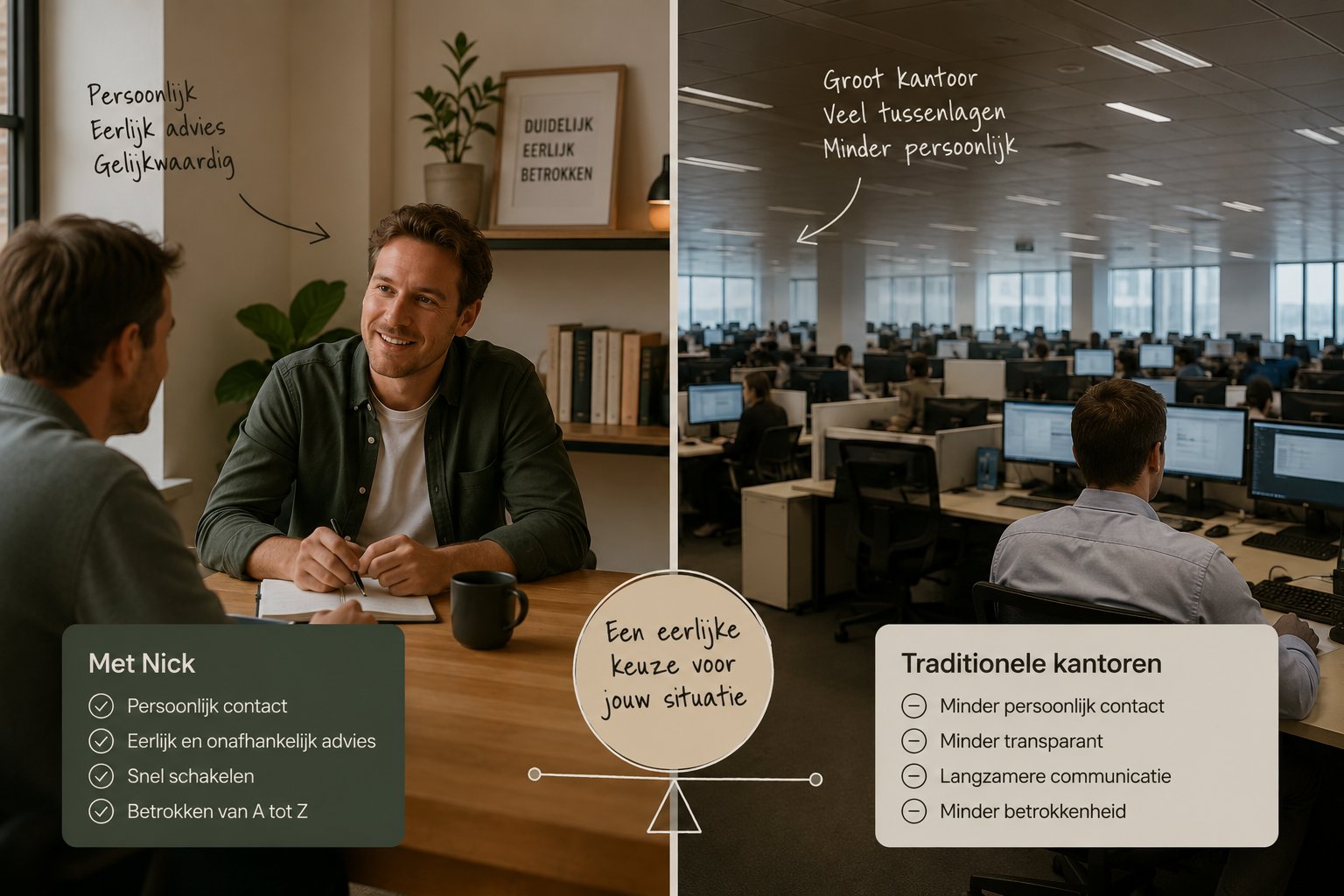

As an IT freelancer, you can work directly for clients, or let an intermediary do the work. Does direct really pay more? And what do you give up if you engage an intermediary? The trade-off is less one-sided than it seems.
In this article I compare both ways honestly, from your perspective as a freelancer. You will read the difference in rate, ease, certainty and compliance. By the end, you will know which route fits your way of working, or whether a mix is smarter.
This blog is for IT professionals working as freelancers: cloud, network, DevOps and security engineers.
Honest disclosure up front: Maedium is itself an intermediary, so I have an interest in one of the two options. I therefore make an extra effort to honestly say when working directly suits you better.
What is the difference between direct and via an intermediary?
Working directly means you find your own clients, negotiate your rate, arrange your contracts and invoice. Via an intermediary you leave (part of) that work to a middleman, who finds assignments, makes the match and, depending on the construction, arranges compliance. You pay a fee for this.
The core of the difference: directly you have maximum control and the highest rate, but you do everything yourself. Via an intermediary you give up part of your margin, but get ease, a flow of assignments and help with compliance in return. It is a trade-off between yield and being unburdened.
What do you earn: direct versus via an intermediary?
Directly you keep your full rate, without a fee. That is financially attractive. With an intermediary a fee is involved, but with the intermediary construction you keep your rate and the fee is passed on to the client. The difference in what you keep is therefore often smaller than you think.
Count your time too. Working directly costs hours of acquisition, negotiation and admin, hours you do not invoice. An intermediary takes that over. Whether direct really pays more therefore depends on how much non-billable time your acquisition costs you.
How much ease does each route offer?
Via an intermediary is by far the easiest: you get assignments offered that fit your profile, and the contracts and compliance are arranged. Directly you do everything yourself, from finding clients to drafting your agreement. That gives control, but costs time and effort.
For some, that own work is enjoyable: you build relationships, decide everything yourself. For others, it is a burden that distracts from what they are good at, namely the technical work. Ask yourself whether acquisition and admin give you energy or cost it.
What about certainty and a stable flow of assignments?
An intermediary can help you to a more stable flow, because they continuously have assignments and match you as soon as something fits. Directly you depend on your own network and acquisition, which can give fluctuations. Idle time between assignments is a bigger risk directly.
On the other hand, working directly you are not dependent on one intermediary's flow of assignments. Many freelancers therefore choose a mix: part via their own network, part via one or two intermediaries. That way you combine a high rate with stability.
Who arranges the Dutch DBA Act compliance?
Directly you carry the compliance entirely yourself, together with your client. With an intermediary it depends on the construction. With intermediation they arrange it in the background; with the intermediary construction they even take the Dutch DBA Act risk off your hands. That is an important advantage for long-running assignments.
Since enforcement tightened in 2025, this has come to weigh more heavily. Clients have become more cautious with direct freelance hiring. An intermediary who arranges compliance takes that worry away from your client, which makes you easier to place. Want to understand this more deeply? Read about the Dutch DBA Act risk for freelancers.
Direct or via an intermediary: what suits whom?
Choose direct if you have a strong network, enjoy acquiring yourself and want the highest rate. Choose an intermediary if you prefer working to hunting, seek a stable flow, or want certainty on compliance. And in many cases, a mix of both is smartest.
Direct suits you if:
- You have a strong network and find assignments easily
- You enjoy acquisition and relationship management
- You want the highest rate and have time to do everything yourself
- You can and want to arrange your own compliance well
Via an intermediary suits you if:
- You prefer working on nice assignments to acquiring
- You seek a stable flow of assignments
- You want certainty on Dutch DBA Act compliance
- You value a personal point of contact who knows your work
Frequently asked questions about direct or via an intermediary
Do I always earn more directly?
Not always. Your rate is higher without a fee, but you spend unpaid time on acquisition and admin. With the intermediary construction you also keep your rate, because the fee goes to the client. Count your time, and the difference is often smaller than it seems.
Can I do both?
Yes, and many freelancers do. You work partly directly via your network and partly via one or two intermediaries. That way you combine a high rate with a stable flow and spread your risk. Just make sure you do not end up at the same client via two parties.
Do I keep my independence via an intermediary?
Yes. With both intermediation and the intermediary construction, you stay an independent entrepreneur with your own rate and freedom. An intermediary does not become an employer. The difference from direct is in who does the acquisition, contracts and compliance, not in your entrepreneur status.
Is an intermediary bad for my margin?
Not necessarily. With the intermediary construction the fee is passed on to the client and you keep your rate. In return, you lose no unpaid acquisition time. Ask the intermediary transparently, so you know exactly how your rate and the fee relate.
What if I work directly now but want more certainty?
Then you can keep working directly for your fixed clients and engage an intermediary for extra assignments alongside. You do not have to choose. Many freelancers build a mix this way that gives stability without giving up their existing relationships.
Conclusion: it does not have to be either-or
Working directly gives you the highest rate and full control, but you do everything yourself. Via an intermediary you give up part of your margin for ease, a stable flow and compliance. The best choice depends on your network, your time and how much you enjoy acquiring.
For whom is direct the best choice? For freelancers with a strong network who like to keep the wheel. For whom not? For those who prefer working to hunting, or want certainty on compliance. In that case, an intermediary, or a mix, is often smarter.
My honest advice: do not put everything on one route. A mix of direct and via an intermediary often gives you the best of both worlds, a good rate and stability.
Curious whether working via Maedium suits you?
Want to spar about whether an intermediary is something for you, alongside your own assignments? Plan a no-obligation call with me. I think along peer-to-peer, even if it turns out you are better off working directly.
Want to join Maedium for assignments that fit your profile? See how to register.
Note: regulations around the Dutch DBA Act may change. For current information, consult rijksoverheid.nl or belastingdienst.nl. If in doubt about your situation, I advise consulting an employment lawyer or tax advisor.