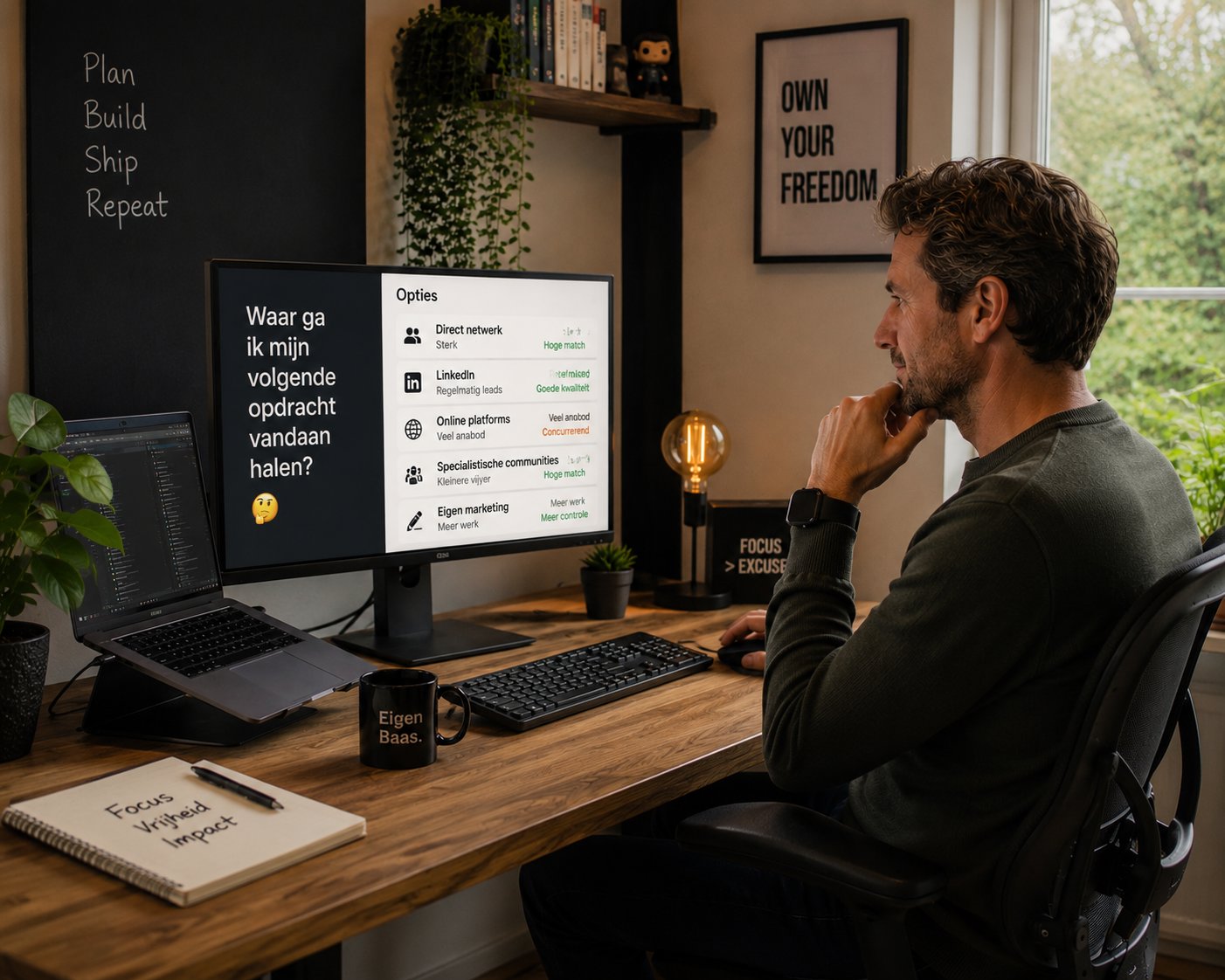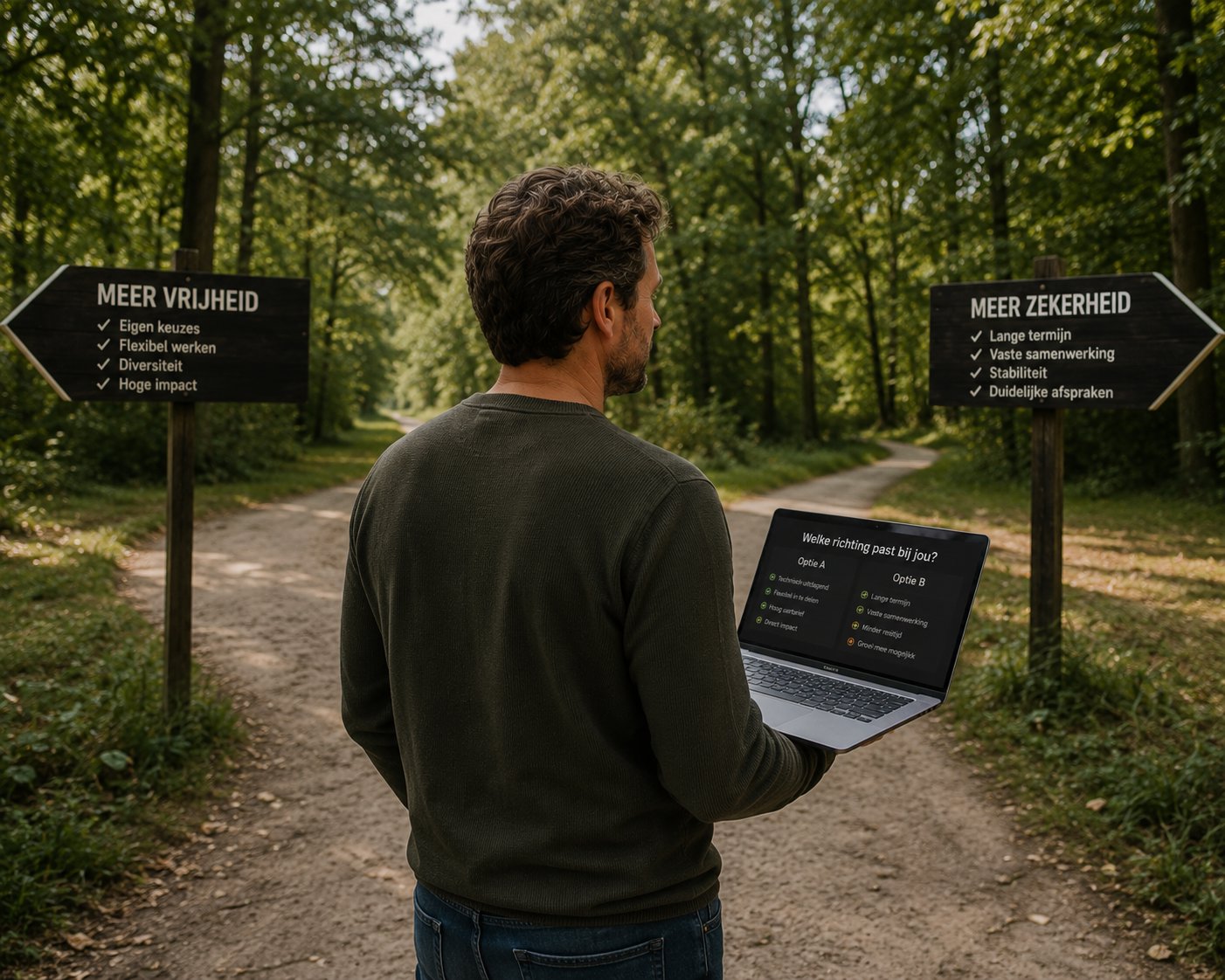

You work in IT and you are torn: do you go freelance, or choose secondment? Do you trade away security along with freedom? And how does the Dutch DBA Act change this picture?
In this article I compare both honestly, from your perspective as an IT professional. You will read the difference in rate, freedom, security and risk. By the end, you will know which form suits your situation, and where the grey middle ground sits.
This blog is for IT professionals: cloud, network, DevOps and security engineers thinking about their way of working.
Honest note first: Maedium places freelancers and offers the intermediary employer construction, so my view is not entirely neutral. I will still try to give you a fair picture below, including the situations where a permanent job makes more sense than either.
What is the difference between freelancing and secondment?
As a freelancer, you are an entrepreneur: you work at your own expense and risk, choose your assignments and invoice yourself. With secondment, you are employed by a staffing firm that lends you to clients. You trade away entrepreneurial freedom, but get security and continued pay in return.
What do you earn: freelance versus secondment?
As a freelancer, you charge a higher hourly rate, often €60–€120 for experienced IT roles, but you pay your own tax, insurance and pension. With secondment, your gross equivalent is lower, but you get holiday pay, continued pay during illness and pension accrual. Net, the difference is smaller than the hourly rate suggests.
Always do the maths. A freelance rate of €90 per hour sounds great, but subtract tax, disability insurance, pension and non-billable hours. What remains is your real income. With secondment, your net is more predictable, but your ceiling is lower.
How much freedom do you have in each form?
As a freelancer, you have the most freedom: you choose your assignments, your rate and your hours. With secondment, the firm partly decides where you end up, though you often have a say. The trade-off is clear: more freedom as a freelancer, more direction and support with secondment.
For some, freedom is everything. For others, it is pleasant that someone else handles acquisition, contracts and admin. Ask yourself how much entrepreneurship you really want. Not everyone good at tech enjoys being an entrepreneur.
How much security does each form offer?
Secondment offers more security: a permanent contract, continued pay between assignments and during illness, and pension accrual. As a freelancer, you carry those risks yourself. No assignment means no income, and you arrange your own safety net. In return, you get a higher rate and more freedom.
This is the heart of the trade-off. How much uncertainty can and do you want to carry? Do you have a buffer, a partner with income, or a full pipeline? Then the freelance risk weighs lighter. If your situation differs, secondment offers calm.
What does the Dutch DBA Act mean for your choice?
The DBA Act makes pure freelancing harder for long-running, embedded assignments. Since 1 January 2025, the Tax Authority enforces actively again. Work full-time at one client for months, and that can count as disguised employment. The intermediary construction is then a safe middle ground.
The Tax Authority looks at authority, whether you do the work personally, and embedding in the organisation. A few risk signals: assignments longer than six to twelve months, fixed hours and location, and more than 70 percent of your revenue from one client.
This is where the intermediary construction comes in. You stay an entrepreneur, but are placed for a specific assignment via a party like Maedium, which sits contractually in between. That way you combine part of the freelance freedom with compliance. Want to know more? Read our guide to the 9 assessment factors of the Dutch DBA Act.
Freelance or secondment: what suits whom?
Choose freelancing if you value entrepreneurship, freedom and a higher rate, and dare to carry risk. Choose secondment if you prefer security, support and a predictable income. Torn because of the DBA Act on a long assignment? Then the intermediary construction is often the best middle ground.
Freelancing suits you if:
- You like setting your own assignments and rate
- You have a buffer and can carry risk
- You enjoy the entrepreneurship alongside the tech
- You have or pursue multiple clients
Secondment suits you if:
- You value security and a fixed income
- You would rather not do acquisition and admin
- You value pension accrual and continued pay during illness
- You are just starting and want to learn within the shelter of a firm
Frequently asked questions about freelancing and secondment
Do you always earn more as a freelancer than via secondment?
Not necessarily. Your hourly rate is higher, but you pay your own tax, insurance, pension and non-billable hours. After deductions, the difference is smaller than it seems. With few assignments, secondment can even work out better thanks to the security.
Can I switch from secondment to freelancing or vice versa?
Yes, and many IT professionals do. Some start at a staffing firm to build experience and a network, then move to freelancing later. Others return to security. It is not an irreversible choice.
Is the intermediary construction a form of secondment?
No. With secondment, you usually become employed by the firm, which becomes the employer. With the intermediary construction, you stay an independent entrepreneur: a party like Maedium sits contractually in between to absorb Dutch DBA Act risk, but does not become an employer and pays no payroll tax. So you keep your independence and more freedom than with classic secondment.
What if I only have one big client?
Then as a pure freelancer you run an elevated DBA Act risk, especially if the assignment lasts long and you become embedded. Consider the intermediary construction, or deliberately arrange multiple clients. One client with more than 70 percent of your revenue is a known risk signal.
Conclusion: which form do you choose?
Freelancing gives you freedom and a higher rate, but you carry the risk yourself. Secondment gives security and support, but your rate and freedom are lower. The DBA Act makes the intermediary construction a serious middle ground for long-running assignments.
For whom is freelancing the best choice? For experienced IT professionals with a buffer and entrepreneurial drive. For whom not? If you are just starting, have little buffer, or hate admin, secondment or the intermediary construction offers more calm.
There is no universally right choice. There is only the choice that fits your stage, your risk appetite and your ambitions.
Want to spar about your way of working?
Torn between freelancing, secondment or the intermediary construction for your next assignment? Plan a no-obligation call with me. I think along peer-to-peer, with no sales pitch.
Note: rates and regulations may change. For current Dutch DBA Act information, consult rijksoverheid.nl or belastingdienst.nl. For complex situations, I advise consulting an employment lawyer or tax advisor.