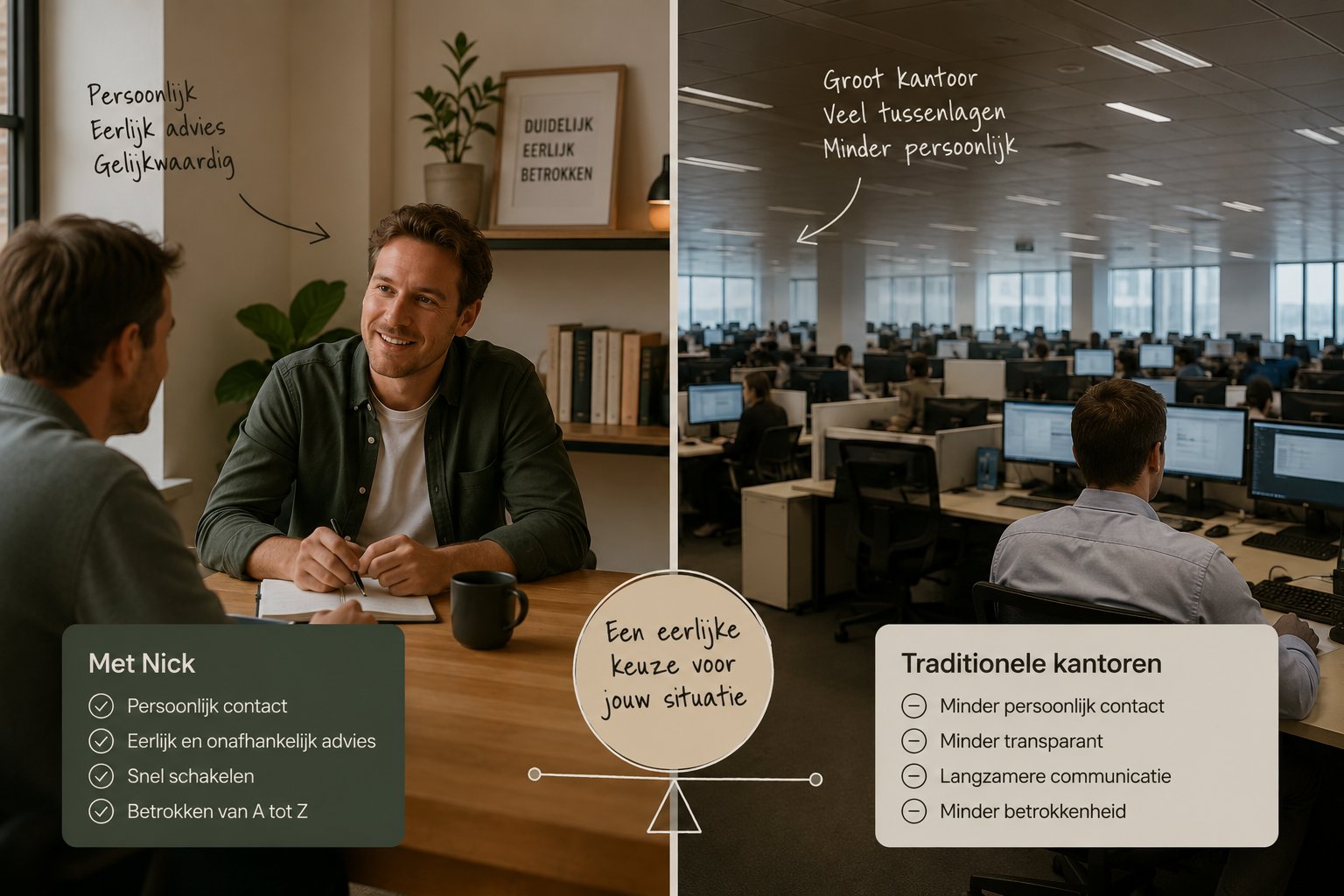

You need IT capacity. Do you go looking yourself, or outsource the recruiting to an intermediary? Both are possible, and both have pros and cons. The question is not which route is objectively better, but which fits your situation.
In this article I compare recruiting yourself and outsourcing honestly, on cost, time, quality and risk. You will read when you are best off searching yourself and when outsourcing pays off. That way you make a choice based on your own situation, not on gut feeling.
This blog is for clients: IT managers and hiring managers looking for capacity who are torn between doing it themselves or outsourcing.
Honest disclosure: Maedium is an IT intermediary, so outsourcing is my trade. That is why I make an extra effort to honestly name when you are better off recruiting yourself.
What do recruiting yourself versus outsourcing actually involve?
Recruiting yourself means you do the whole process internally: posting a vacancy or assignment, finding and screening candidates, holding interviews, negotiating and contracting. Outsourcing means you engage an intermediary who takes over that process and proposes a suitable candidate.
The core of the difference lies in where the time and the risk sit. Recruiting yourself costs your time and knowledge, but you keep full control and pay no fee. Outsourcing costs a fee, but saves you time and places part of the risk with the intermediary.
What does recruiting yourself really cost?
More than you think, because the costs are mainly hidden time. Searching, screening and interviewing candidates costs you or your team hours that do not go to your actual work. For a scarce profile, that can run up to weeks of lead time, with the risk that you still find no one.
On top of that comes the risk of a wrong match. If you hire someone yourself who disappoints, that costs time, money and delay on your project. And you carry full responsibility for Dutch DBA Act compliance yourself. Those hidden costs often make "free" self-recruiting more expensive than it seems.
What does outsourcing deliver?
Outsourcing mainly delivers time, speed and certainty. An intermediary has a network, knows the market, and proposes a pre-selected candidate. You save the search time, get someone faster, and with the intermediary construction the intermediary takes on the Dutch DBA Act risk.
Against that stands a fee, usually 10 to 15 percent. Whether that pays off depends on what your time is worth and how scarce the profile is. For a scarce profile or an urgent assignment, the fee often pays for itself in saved time and a better match. For a simple, non-urgent job, recruiting yourself can suffice.
When are you better off recruiting yourself?
Recruiting yourself pays off if you have a strong network, time to search, and enough knowledge to assess candidates. Also for a simple, non-scarce profile or a fixed freelancer you already know, an intermediary adds little. In those cases you save the fee without giving up much.
If you have an internal recruiter or HR department at home in IT profiles, you can handle a large part yourself. It depends on whether you have that capacity and knowledge in house. If not, you risk putting a lot of time into a search a specialist would have cracked faster.
When is outsourcing the smarter choice?
Outsourcing pays off if you seek a scarce profile, have little time, have no IT network, or want certainty on the Dutch DBA Act. Also with urgency, an intermediary is faster, because they search a ready network directly. You then buy in time, expertise and risk cover.
The combination of scarcity and compliance in particular makes outsourcing attractive. A scarce security or DevOps specialist is hard to find yourself, and for a long-running assignment you do not want to carry the Dutch DBA Act risk yourself. An intermediary solves both at once. Want to know which hidden costs self-hiring brings? Read our blog on the hidden costs of IT hiring.
Frequently asked questions about recruiting yourself or outsourcing
Is recruiting yourself cheaper than outsourcing?
In fee yes, but not always in total. Recruiting yourself costs a lot of time, and a wrong match or a Dutch DBA Act back-tax assessment can work out more expensive than a fee. Count your own time and the risk, and the difference is often smaller than it looks on paper.
Can I combine recruiting myself and outsourcing?
Yes, and many clients do. You recruit yourself for roles you find easily, and outsource scarce or urgent profiles. That way you save fee where you can and buy in expertise where you must. It does not have to be either-or.
How long does recruiting yourself take on average?
That depends strongly on the scarcity of the profile. A common profile you might find within a few weeks, a scarce specialist can take much longer or not work out at all. An intermediary with a ready network is usually faster, especially with scarcity.
Who carries the Dutch DBA Act risk if I recruit myself?
With recruiting yourself and hiring directly, you carry the Dutch DBA Act risk entirely yourself, together with the freelancer. If you outsource via the intermediary construction, the intermediary takes on that risk. For long-running or embedded assignments, that is an important difference.
Do I need an internal recruiter to recruit myself?
Not necessarily, but it helps enormously if you have someone who can assess IT profiles and knows the market. Without that knowledge, recruiting yourself costs more time and the risk of a mismatch is greater. In that case, outsourcing is often more efficient.
Conclusion: choose based on time, knowledge and scarcity
Recruiting yourself saves the fee but costs time, knowledge and risk. Outsourcing costs a fee but delivers time, speed and certainty. The smartest choice depends on your network, your available time, the scarcity of the profile and how much risk you want to carry yourself.
For whom is recruiting yourself smart? For clients with a network, time and knowledge, or a simple profile. For whom is outsourcing smarter? For those seeking a scarce profile, with little time, or wanting certainty on compliance. Often a combination is wisest.
My advice: look not only at the fee, but at the total cost including your own time and risk. Sometimes doing it yourself is smartest, sometimes outsourcing. Choose deliberately per situation.
Unsure whether to recruit a role yourself or outsource it?
Want to spar about which approach fits a specific assignment? Plan a no-obligation call with me. I think along honestly, even if it turns out you are better off doing it yourself.
Note: regulations around the Dutch DBA Act may change. For current information, consult rijksoverheid.nl or belastingdienst.nl. For complex situations, I advise consulting an employment lawyer or tax advisor.